BEGIN:VCALENDAR
VERSION:2.0
PRODID:-//ChamberMaster//Event Calendar 2.0//EN
METHOD:PUBLISH
X-PUBLISHED-TTL:P1H
REFRESH-INTERVAL:P1H
CALSCALE:GREGORIAN
BEGIN:VTIMEZONE
TZID:America/Chicago
BEGIN:DAYLIGHT
RRULE:FREQ=YEARLY;BYMONTH=3;BYDAY=2SU
DTSTART:20070101T000000
TZOFFSETFROM:-0600
TZOFFSETTO:-0500
TZNAME:Central Daylight Time
END:DAYLIGHT
BEGIN:STANDARD
RRULE:FREQ=YEARLY;BYMONTH=11;BYDAY=1SU
DTSTART:20070101T000000
TZOFFSETFROM:-0500
TZOFFSETTO:-0600
TZNAME:Central Standard Time
END:STANDARD
END:VTIMEZONE
BEGIN:VEVENT
DTSTART;TZID=America/Chicago:20241024T160000
DTEND;TZID=America/Chicago:20241024T180000
X-MICROSOFT-CDO-ALLDAYEVENT:FALSE
SUMMARY:CRE Forum Series Presented by Michael Best: Municipal Special Charges
DESCRIPTION:The cost of running a municipality is supposed to be paid primarily through real estatetaxes. Suddenly we are seeing municipalities starting to create many additional "specialcharges\," including transportation fees\, emergency services fees\, and "good neighbor"fees\, either for services formerly included in taxes\, or as a condition of approvals ofdevelopment. Can they charge these fees? How do these special charges relate to thelevy limits established by the Wisconsin Legislature? Do they violate the Impact Fee Law?\nIssues include:The Wisconsin Impact Fee Law\, created in 1993\, defines "impact fees" as "cashcontributions\, contributions of land or interests in land or any other items of valuethat are imposed on a developer by a municipality under this section\," meaning asa condition for development. The Impact Fee Law requires that the municipalitystudy the need for the fee\, apportion it equitably over the developments that causethe need for the fee\, keep it in an escrow account\, spend it only for that purpose\,and reimburse any unused funds to the donor developer.The Levy Limits imposed by the Wisconsin Legislature\, tightly control how taxescan be increased in a municipality to pay for operational costs\, causingmunicipalities to seek other means of covering escalating costs.A number of municipalities have instituted new "special charges" either billed as"special use fees" to property for ongoing costs\, or charged as a condition ofapproval of development\, without following the Impact Fee Law.Lawsuits have already been filed against municipalities to challenge these fees\,and the application of these special charges to particular users\, which are likely tobe long and expensive arguments.How can the property owner and developer's needs and rights for predictablecosts\, to be balanced against a municipality's need to balance its budget.
X-ALT-DESC;FMTTYPE=text/html: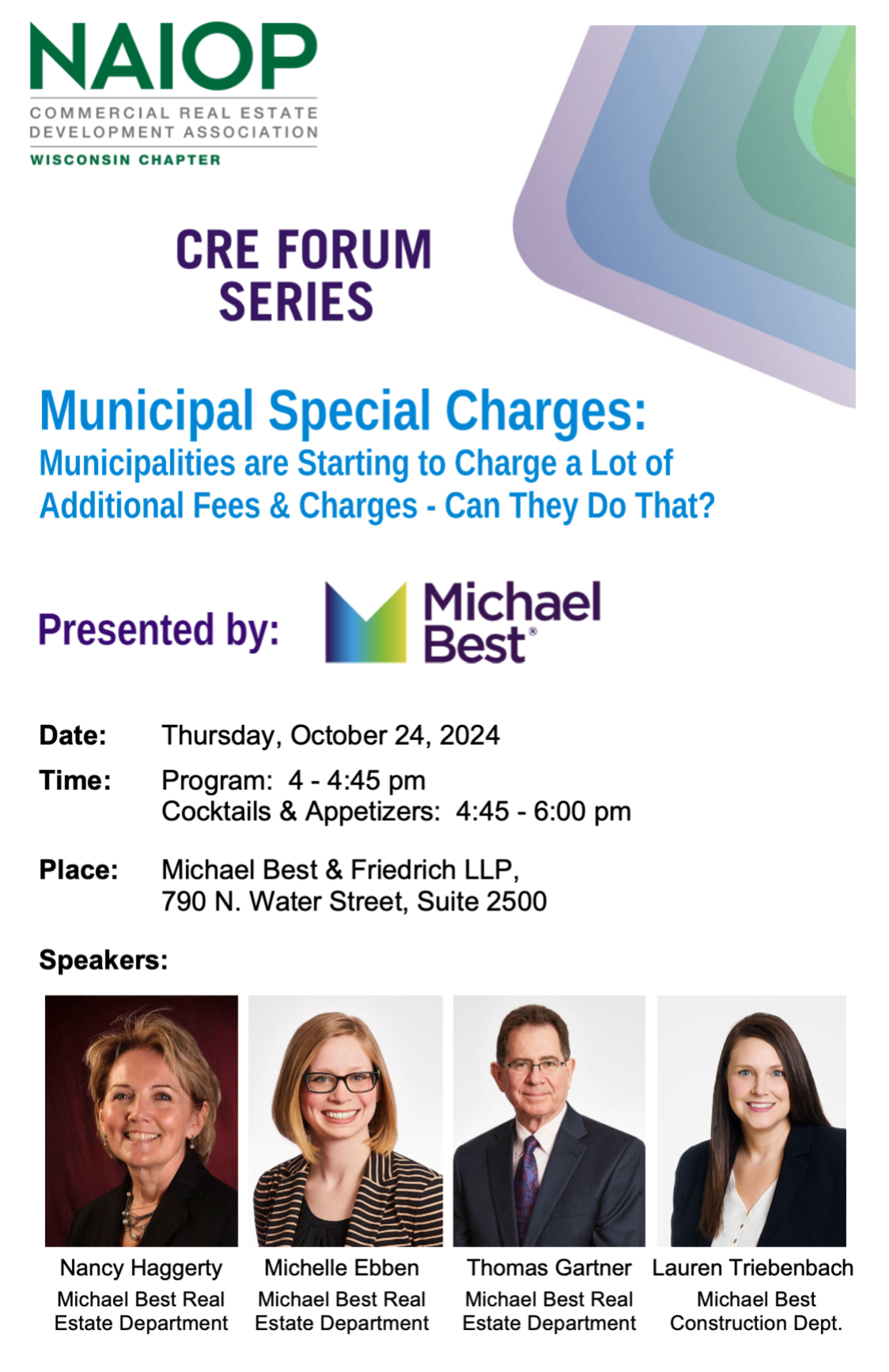
The cost of running a municipality is supposed to be paid primarily through real estate
taxes. Suddenly we are seeing municipalities starting to create many additional &ldquo\;special
charges\,&rdquo\; including transportation fees\, emergency services fees\, and &ldquo\;good neighbor&rdquo\;
fees\, either for services formerly included in taxes\, or as a condition of approvals of
development. Can they charge these fees? How do these special charges relate to the
levy limits established by the Wisconsin Legislature? Do they violate the Impact Fee Law?
Issues include:
- The Wisconsin Impact Fee Law\, created in 1993\, defines &ldquo\;impact fees"\; as &ldquo\;cash
contributions\, contributions of land or interests in land or any other items of value
that are imposed on a developer by a municipality under this section\,&rdquo\; meaning as
a condition for development. The Impact Fee Law requires that the municipality
study the need for the fee\, apportion it equitably over the developments that cause
the need for the fee\, keep it in an escrow account\, spend it only for that purpose\,
and reimburse any unused funds to the donor developer.
- The Levy Limits imposed by the Wisconsin Legislature\, tightly control how taxes
can be increased in a municipality to pay for operational costs\, causing
municipalities to seek other means of covering escalating costs.
- A number of municipalities have instituted new &ldquo\;special charges&rdquo\; either billed as
&ldquo\;special use fees&rdquo\; to property for ongoing costs\, or charged as a condition of
approval of development\, without following the Impact Fee Law.
- Lawsuits have already been filed against municipalities to challenge these fees\,
and the application of these special charges to particular users\, which are likely to
be long and expensive arguments.
- How can the property owner and developer&rsquo\;s needs and rights for predictable
costs\, to be balanced against a municipality&rsquo\;s need to balance its budget.
LOCATION:790 N. Water St. #2500 Milwaukee WI 53202-4108
UID:e.2714.1053205
SEQUENCE:3
DTSTAMP:20260924T170332Z
URL:https://members.credawi.org/event-calendar/Details/cre-forum-series-presented-by-michael-best-municipal-special-charges-1212963?sourceTypeId=Hub
END:VEVENT
END:VCALENDAR